Reimagining Engineering Education with Interactive VR Aircraft Engines

An immersive Meta Quest 3 VR module allows users to explore, dissect, and understand aircraft engine systems through interactive 3D visuals, guided narration, and real-time system animations.
Industries
DefenseManufacturing
Services
3D VisualizationE Learning SolutionsEnvironment ModelingImmersive AR and VR TrainingsProduct Animation

Introduction

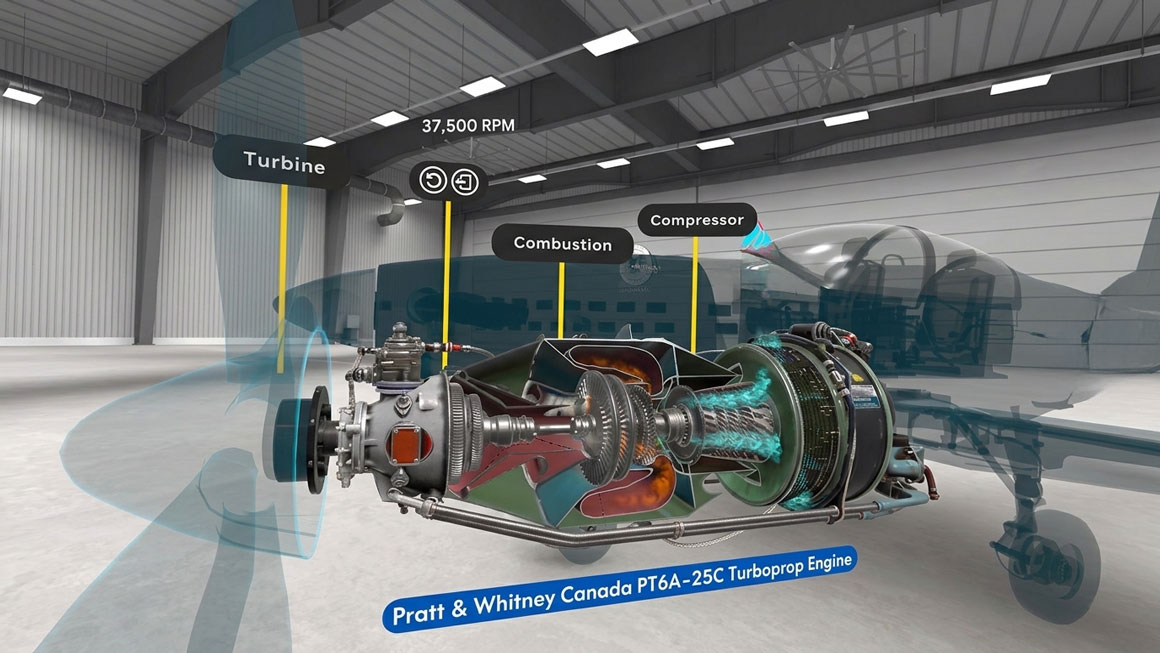
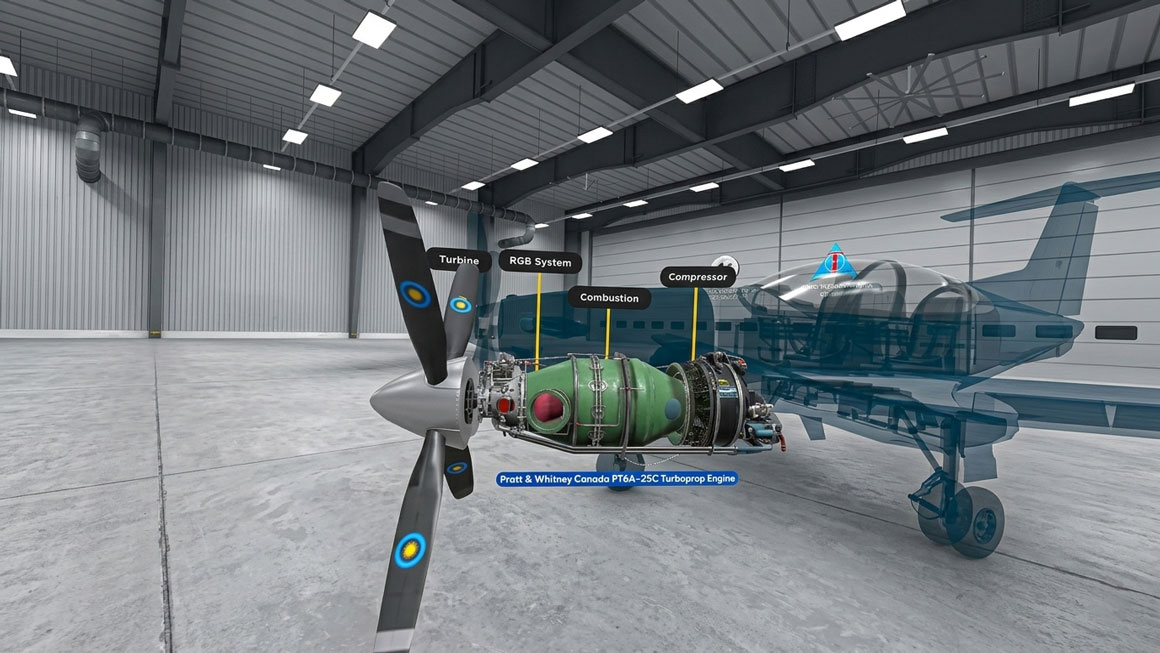
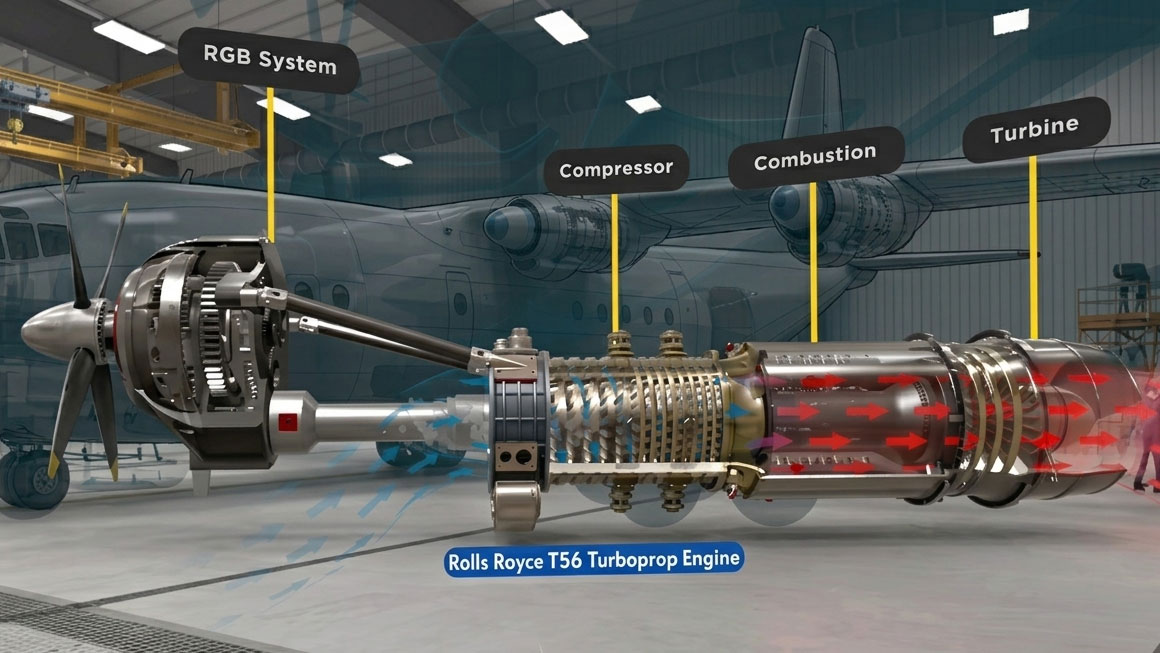
The project created an interactive 3D learning experience on Meta Quest 3 focused on two aircraft engines: Rolls Royce T56 and Pratt & Whitney PT6A-25C. Users can explore engines in a virtual hangar and examine parts up close through interactive 3D visuals and animations.

Learners can inspect components, view animated system operations, and understand airflow, combustion, compression, and turbine mechanics through synchronized audio and visual guidance.
Project Highlights

The vision was to simplify complex propulsion engineering concepts into an intuitive, immersive, and interactive learning module, without overwhelming the user with excessive technical density.

Key Highlights

  • Virtual Hangar menu with aircraft selection for intuitive navigation
  • Engine highlight and teleport interaction flow for focused learning
  • Exploded-view animations with cross-sectional transparency
  • Four interactive engine systems per aircraft: Reduction Gear Box (RGB), Compressor, Combustion, Turbine
  • Realistic airflow, fire, exhaust, and mechanical rotation animations
  • “Play Full Engine Animation” flow for complete system overview
  • Standalone build optimized for Meta Quest 3 performance
  • Structured learning progression from aircraft selection to system-level animation, ensuring clarity and engagement

Technical Challenges

Aircraft engines are intricate mechanical systems involving high-speed rotating assemblies, airflow channels, fuel combustion sequences, and exhaust mechanics.

Key challenges included:

  • Optimizing high-detail engine meshes for standalone Quest 3 hardware
  • Reassembling and restructuring STL-based T56 engine files
  • Creating cross-sectional and transparent system views
  • Accurately animating airflow and combustion sequences
  • Syncing narration timing with mechanical animation
  • Maintaining real-world scale accuracy in VR

Additionally, both aircraft models required reskinning and texture enhancement to align with real-world aircraft.

Our Solution & Strategic Approach

We implemented a modular VR learning framework combining high-fidelity 3D production with structured interaction design to deliver an immersive educational experience.

Strategic Implementation

Strategic Implementation

  • Optimized and retextured aircraft and engine models
  • Built a virtual hangar as a navigational hub
  • Developed controller-based and interaction-triggered workflows
  • Created exploded-view engine reveal animation
  • Developed system-level animated flows for airflow, combustion, and turbine rotation
  • Integrated synchronized voiceover narration
  • Delivered a standalone APK build optimized for Meta Quest 3
The user journey follows a clear instructional path

The user journey follows a clear instructional path

  • Select aircraft in hangar
  • Highlight engine
  • Trigger exploded/cross-section reveal
  • Interact with RGB, Compressor, Combustion, or Turbine systems
  • View detailed airflow and component movement animations

This approach turns static technical documentation into an interactive, experiential learning environment.

The Impact

  • Improved propulsion system understanding through immersive visualization
  • Increased knowledge retention via interactive experiential learning
  • Enabled safe exploration of complex aircraft engines
  • Reduced reliance on physical engines for training
  • Created reusable VR modules for aviation education
  • Established scalable framework for future aircraft systems

Ready to bring complex aircraft systems to life with immersive VR training?

Build Your VR Module